


A driveway in pieces looks manageable until someone tries to lift the first slab. Council hard rubbish will not touch it. A mate with a trailer will do two loads and give up. A general waste skip will take the lot, then bill it as mixed junk, which is a poor trade when clean concrete can be recycled into road base. That is the whole point of concrete skip bin hire. Heavy waste, kept separate, priced as what it is.
Rubbish Skip Hire drops concrete skips across Melbourne for home jobs, builders and anyone managing a site that has just lost a slab. Most deliveries land inside 24 to 48 hours once the postcode is in. The rest of this piece is the practical bit. What belongs in the bin, what will get a load rejected, and how not to book a 3m3 bin for a 6m3 driveway.
Concrete is a different kind of waste
A cubic metre of broken slab is a serious weight. Stack bricks and tile on top and you are well past what a mixed rubbish price assumes. General waste skips are tipped as mixed waste. That rate is higher, and the material does not get a second life as road base.
Put the same driveway in a concrete skip and, if you kept it clean, it can go to a recycler. Timber offcuts, a roll of old carpet, a bag of plaster, even a decent amount of soil, and that recycling path closes. Sometimes the whole load gets reclassified. You pay for the mistake on collection day, not when you were feeling efficient with one bin for everything.
Our bins for this work are plain steel. They cop slabs being tossed in. From 3m3 up, the rear door hinges open so a wheelbarrow rolls in. That sounds like a small feature until you have spent an hour throwing concrete over a high side.
Soil is not the same booking. Excavated dirt wants a soil skip. Timber, cabinets, packaging and the usual reno leftovers want a general waste skip. The waste type you tick at the start is the decision that saves the most money. Everything after that is loading discipline.
What a concrete skip will take
Think of the bin as a home for material that used to be hard and inert. Slab. Path. Bricks. Tiles. Rock.
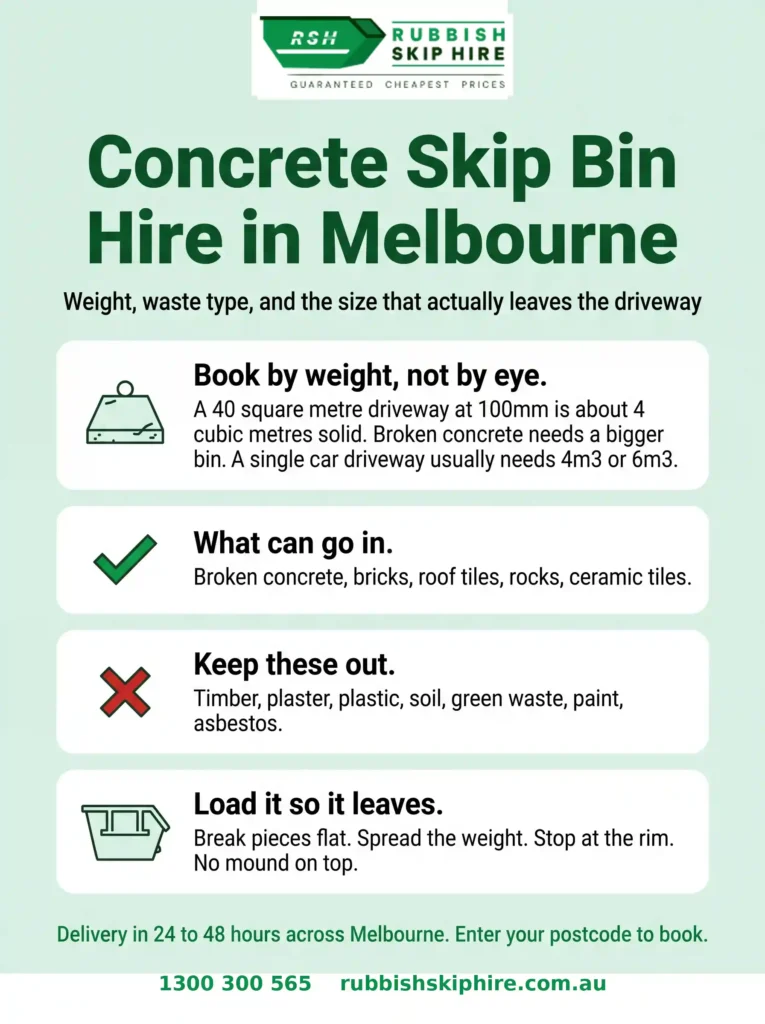
A clean load can include broken concrete from driveways, shed floors and old paths. Bricks and brick rubble. Terracotta and concrete roof tiles. Rocks and stones. Ceramic tiles, once the adhesive mat and underlay are off them. Small amounts of sand mixed through a hard fill load are usually fine if you have said so at booking and we have confirmed it.
That is the list. It is shorter than people hope.
The failures are boring and predictable. A few lengths of timber shoved under the slabs. Plaster from the bathroom that came out the same afternoon. Green waste because the garden bed was in the way of the jackhammer. Plastic wrapping off the new pavers. Paint tins, even empty ones. Any of those can spoil a clean hard fill load.
Asbestos is not a grey area. Do not put suspected asbestos in a skip. Old fibro leaning on the fence needs a licensed removalist, not a quiet spot at the bottom of the bin. If you are not sure, leave it out and get it identified before we arrive. Wet paint, oil and chemicals are the same story. They contaminate. They do not get a free ride because the tin looks empty.
Soil as the main waste is a no. Clay from a pool excavation or a front yard scrape belongs in a soil skip bin. A landscaper who pulls a path and also digs the garden usually needs two bins. Mixing those streams feels thrifty for about a day.
Weight is the real size question
People book by eye. Concrete should be booked by area and thickness.
A short path, or a couple of square metres of 100mm slab, often sits in a 2m3 or 3m3 bin if nothing else is going in and the pieces are broken small. A single car driveway, once it is in chunks, commonly needs a 4m3 or 6m3 concrete skip. The pile always looks smaller on the grass than it does in the bin. A double driveway, a patio plus a path, or brick and concrete together from a small knock down, is often 6m3 to 9m3, and it is a conversation rather than a guess. Full house slabs and commercial strip outs need a weight check before anyone orders the biggest bin on the page. A second lift is cheaper than an overloaded truck that cannot leave.
There is a volume trick worth knowing. Solid concrete and broken concrete are not the same space. A 40 square metre driveway at 100mm is about four cubic metres while it is still a slab. Break it and the gaps eat capacity. A 4m3 bin that looked generous on paper is suddenly short. That is the usual reason a “small” driveway job overflows.
Over the rim is a refusal. Waste has to sit level with the sides, or under. Drivers will not cart a mound of concrete, and you will be standing there pulling pieces back out while the truck waits, or worse, while it leaves and rebooks. Legal weight on the road matters as much as the cubic metres printed on the size chart.
Which skip bin size suits concrete
Sizes run from 2m3 to 12m3. Heavy waste does not automatically want the biggest one. A 12m3 bin full of solid slab can be over the truck long before it looks full.
For a bathroom floor of tiles and mortar, 2m3 is often enough. Top load only on that size. A bigger tiled room, or a short section of path, suits a 3m3 with the rear door. A modest driveway section or a garage floor usually wants 4m3, assuming the pieces are manageable. The 6m3 is the one we see most for a home driveway, a patio, or a builder clearing a few days of brick and concrete. Walk in access changes the speed of the day. 8m3 and 9m3 cover larger renovations and lighter commercial demolition, still with an eye on weight. 10m3 and 12m3 make sense when the volume is high and the load is not pure slab from top to bottom. Ask before you fill a big bin with nothing but concrete. We would rather send the right truck.
If you want the range in one place before you ring, it is on our skip bin sizes page.
Concrete skip, hard fill skip, or general waste
Quotes go wrong when these three get treated as interchangeable.
Concrete skip bin hire is the direct option for slabs, paths, tiles and brick. Start on the concrete skip bin page if that is the whole job.
Hard fill is the wider family. Concrete, bricks, rocks, stones. If the pile is a clean mix of those and almost nothing else, a hard fill skip is often the booking. Same rule. Keep it clean.
General waste is the messy half of a renovation. Timber, plaster, packaging, old cabinets, and some rubble if it has to. It is the wrong economy when the load is mostly concrete, because mixed waste costs more to process. Use it beside the concrete bin, not instead of it.
Soil sits on its own page for a reason. Our soil waste bins take clay, excavated dirt and clean soil. Concrete in that bin, or dirt in the concrete bin, is how a straightforward hire turns into a contaminated load.
October is when the slabs come up
The ground has dried out. Days are longer. People want the outside finished before the Christmas shutdown, and concreters book out. That is why concrete waste spikes through spring in Melbourne.
Driveway replacements are the obvious one. Old concrete or a tired asphalt edge comes up, the base gets corrected, and the new surface cannot go down while the old material is still on the nature strip. Book the skip for the demolition morning, not for the pour date. Those are different days, and the gap is where bins get ordered late.
Patios from the 1980s are another regular. Cracked, thick, and heavier than the photos suggest. Once it is broken, a lot of them land between 4m3 and 6m3. If the pergola posts are coming out too, stack the timber somewhere else.
Bathroom and laundry strip outs catch people. Floor tiles on a fat mortar bed fill a 2m3 or 3m3 before the vanity has moved. The lighter rubbish from that same room does not belong in the concrete skip. Two streams, even on a small job.
Granny flats and rear unit builds in the growth suburbs produce both a slab and a pile of mixed waste. A builder in Tarneit or Werribee will often run a concrete or hard fill bin next to a general waste bin so the machine operator is not making the sorting decision at 4pm.
Then there are the small ones that are not small. Every fence post footing dug out and stacked. Garden edges. A path to the side gate. A 2m3 can be right, if that really is all that is coming out. Measure before you decide it is “just a few bits”.
Commercial work is the same logic with tighter access. A shopfront refit, a unit block path, a body corporate tidying cracked common concrete. The bin has to land, get filled, and leave without blocking residents. Tell us the access limits when you book and we will aim the delivery window at the building, not just the truck run.
Before the truck turns up
A correct size still fails if the truck cannot set the bin down.
Skip trucks need width to reverse and height to tilt. Low branches, a carport, a side driveway that feels fine in a ute, those are the usual stops. The bin wants solid, level ground. Lawn will mark, and a full concrete load will mark it properly. A sheet of ply under the feet helps a bit. It will not save a soft verge. Driveways are the easy answer when the bin can sit on the property.
Look up as well as along the path. Wires and the lift arc matter.
Street placement is a council question, not a courtesy question. Some councils are relaxed about a nature strip for a short hire. Others want a permit, and the fine lands on you, not on the driver. Inner suburbs are stricter than a wide western court. Check before delivery day if the bin cannot live entirely on your land.
Clear cars, wheelie bins and trailers off the landing spot. A blocked drop off becomes a redelivery, and redelivery is a fee you did not plan for. If access is awkward, say so on the booking. A side gate that takes a wheelbarrow is not a truck entrance. We would rather place the bin on the front drive than hear about a failed drop after the fact.
How the booking actually works
Enter the postcode, pick the waste type, pick the size. The postcode is not admin. Price and which truck can do the run both sit behind it. A bin in Point Cook is not the same job as a bin in Reservoir. What makes the quote accurate is ordinary detail. Suburb and postcode. Waste named as concrete, or as mixed hard fill if bricks and tiles are in with it. Square metres and thickness, or a photo of the pile. How many days you need the bin. Anything odd about access, including a steep drive or a rear lane.
Delivery is commonly 24 to 48 hours, sooner if a truck is already nearby. Pickup is either the date you set or a call when you are done. If the job runs long, ring before the scheduled lift. Extra days are cheaper to arrange than a driver turning up to a bin you still need.
Weight sits inside the price on this waste type. A concrete skip is not priced like a half empty household bin. Ask what the allowance includes, and what happens if you go over. A clear number now beats an argument on the morning of collection.
Call 1300 300 565 if you would rather talk the job through. Photos help either way.
Loading so the first collection works
Break pieces small enough to sit flat. A slab that bridges the bin wastes space and sticks above the rim even when the bin is not truly full. Eye and ear protection if you are on the jackhammer. Obvious, and still skipped.
Heavy pieces in first, weight spread, not stacked on one side. Uneven loads shift.
Stop at the rim. The last few chunks “just on top” are the ones that get a bin refused. If material is left, book a second bin or a swap. That phone call is the cheap version.
Keep contaminants out to the last barrow. End of the day is when timber gets tossed in because the other bin has already gone. One decision, whole load reclassified.
Rain is not a problem for concrete the way it is for plaster and cardboard. Neighbours are. A bin on the street fills with other people’s rubbish faster than the demolition does. You booked it. You wear what is in it.
Where we drop them
Concrete skips go out across the suburbs we cover, from inner north renovations to the western growth areas where new driveways and rear units keep producing heavy waste.
Regular runs include Werribee and Hoppers Crossing, Tarneit and Point Cook, Melton and Caroline Springs. North and west, Sunshine, St Albans, Craigieburn, Epping and Thomastown. Closer in, Preston, Reservoir, Coburg and Footscray.
The longer list is on service areas. If your suburb is there, concrete skip hire is available. Still enter the postcode. The local price is the one worth booking against.
What moves the price
You will not get a quote in Melbourne without a postcode. Concrete skip hire moves with bin size and the weight allowance on that size, how far the truck runs, how long you keep the bin, whether the load stays clean enough to recycle, and any council permit if the bin is on the street.
Clean concrete is usually cheaper to process than mixed waste. That is the saving in separating it. The hire itself still reflects weight. A small bin full of tile and mortar can cost more than a larger bin of light household junk. Compare the same waste type, not two different jobs.
A few habits keep the bill in check. Measure, or send photos, before you lock a size. Do not oversize out of nerves, and do not undersize to shave the hire fee. A second delivery costs more than getting the first size right. Keep timber and plaster out so the concrete bin stays a concrete bin. Have the pile ready, or the crew ready, so the bin is not sitting half empty for a week. Book pickup once the last of the slab is in.
A job in Hoppers Crossing last spring is a fair picture of the tidy version. About 35 square metres of driveway, around 100mm thick, plus a short path to the meter. The owner booked a 6m3 concrete skip for the morning the slab was coming up, pickup two days later, bin on the property so no council permit. Door faced the work. The crew broke the concrete, barrowed it in, and stopped at the rim. A stack of old timber edging stayed on the porch and went out later with household junk. The concreter turned up to a clear base.
The messy twin of that job is a 3m3 booked to save the hire fee, pieces left too big, and half the slab still on the lawn when the new crew arrived. That one is the phone call we would rather not take.
Concrete is too heavy, and too recyclable, to hide in the wrong skip. A dedicated bin keeps the load clean, ties the price to what you are actually throwing out, and gets the slab off the site before the next trade needs the space.
Match the size to area and thickness. Keep timber, soil and household rubbish out. Leave the truck a straight path in, and do not load above the rim. Across Melbourne, from Werribee and Melton through to Craigieburn, Preston and the inner suburbs, our team can drop a concrete skip and take it when it is full.
Check the postcode, choose concrete as the waste type, and if you are stuck between two sizes, ask before you pay for the wrong one.
Book through here or call 1300 300 565.
FAQs About Concrete Skips
Broken concrete, bricks, tiles, rocks and similar clean building rubble. Timber, plaster, plastic, green waste and soil stay out. A clean load can be recycled. A mixed load often cannot.
No. Excavated dirt needs a soil skip. Mixing the two contaminates the load and can change both the price and where it is tipped.
A typical single car driveway, broken into pieces and loaded level, is a common fit, as long as it stays inside the weight allowance. Send the square metres and thickness if you want a firmer answer than a guess from photos.
On your own property, usually no. On the street or the nature strip, many councils want a permit. Check locally before delivery day. The rules are not the same from one council to the next.
For most suburbs we cover, inside 24 to 48 hours after the booking is confirmed. Quicker if a truck is already working nearby.
Close, not identical. Hard fill takes concrete, bricks, rocks and stones. A concrete skip is aimed at concrete removal. If the pile is a clean mix, either can be right. Tell us what is actually in it.
A bin above the rim will not be taken, and an overweight load can be refused or billed extra. Pull the excess out, or book another lift. That is safer than a failed collection.
No. Asbestos does not go in any skip. Use a licensed removalist. If fibro might be mixed through an old slab, stop and get it checked before the bin is filled.
Yes. Driveways, granny flats, shop refits and larger demolition all use the same service, with size and weight matched to the job. Site managers can ask for a delivery window that suits access.
Enter your postcode on the hire skip bin page, select the waste type, and choose a size. Or call 1300 300 565 with the measurements. Photos make the quote faster.


